


 |


| Quantity: | |
|---|---|
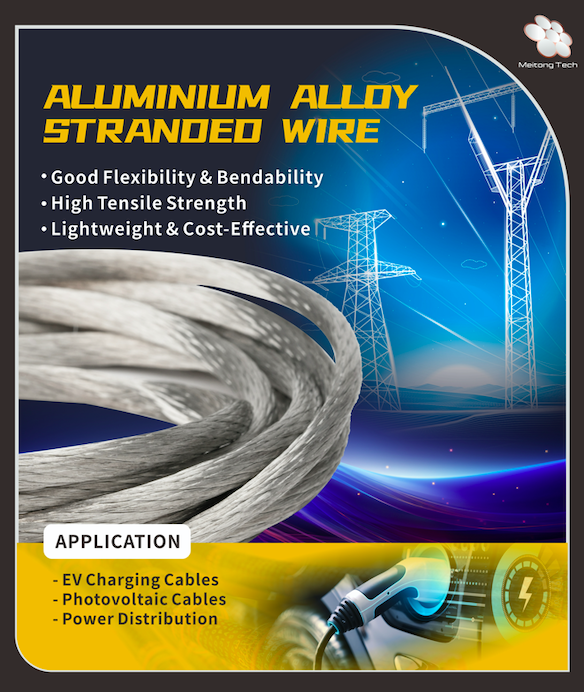
Aluminium Alloy Stranded Wire is a high - performance solution that strikes an optimal balance among conductivity, weight reduction, and mechanical strength. It serves as a versatile choice for multiple industries, catering to applications where efficiency and durability are paramount.
Lightweight: Weighs about 50% less than copper, making it ideal for weight - sensitive installations. This property eases transportation, handling, and reduces structural loads in applications like overhead lines.
Good Conductivity: Fulfills the performance requirements of numerous low - voltage applications. Ensures efficient electricity transmission, minimizing power losses during distribution.
Corrosion Resistance: The treated alloy surface resists oxidation, enhancing the wire's lifespan, especially in harsh environmental conditions such as coastal or industrial areas.
Cost - Effective: A perfect fit for large - scale projects. Its lower material cost compared to some alternatives, combined with weight savings, reduces overall project expenses.
High Tensile Strength: Offers enhanced mechanical durability, enabling it to withstand mechanical stresses during installation and operation, like wind loads on overhead lines.
Automotive: Used in wiring harnesses and EV charging cables, where its lightweight and conductivity contribute to vehicle efficiency and performance.
Power Distribution: Essential for distributing electricity in urban and rural grids, ensuring reliable power delivery.
Overhead Lines: Ideal for overhead power transmission due to its lightweight and high tensile strength, reducing the need for excessive structural support.
Building Wiring: Suits internal building wiring, providing a cost - effective and efficient electrical conduction solution.
• Solar Cables (PV Cables): lighter conductor material for big solar project installation
Customized plating thickness: Tailor the plating to meet specific environmental and performance needs.
Special strand constructions: Design the stranding pattern to optimize flexibility, strength, or other mechanical properties.
Specific resistance and tensile targets: Match the wire's electrical and mechanical characteristics precisely to your project requirements.
Insulation & shielding options: Choose the right insulation and shielding materials for enhanced safety and performance in different applications.
Specification and Technology date | |||||||
Code | Nom.area | Stranding | cla Size | O.D | mass | Strength | Resistance(20℃) |
mm² | No./mm | mm² | mm | kg/km | kgf | Ω/km | |
Box | 15 | 7/1.85 | 18.82 | 5.55 | 51 | 537 | 1.7495 |
Acacia | 20 | 7/2.08 | 23.79 | 6.24 | 65 | 680 | 1.384 |
Almond | 25 | 7/2.34 | 30.1 | 7.02 | 82 | 861 | 1.0934 |
Cedar | 30 | 7/2.54 | 35.47 | 7.62 | 97 | 1014 | 0.9281 |
- | 35 | 7/2.77 | 42.18 | 8.31 | 115 | 1205 | 0.7804 |
Fir | 40 | 7/2.95 | 47.87 | 8.85 | 131 | 1367 | 0.688 |
Hazel | 50 | 7/3.30 | 59.87 | 9.9 | 164 | 1711 | 0.5498 |
Pine | 60 | 7/3.61 | 71.65 | 10.83 | 194 | 2048 | 0.4594 |
- | 70 | 7/3.91 | 84.05 | 11.73 | 130 | 2402 | 0.3917 |
Willow | 75 | 7/4.04 | 89.73 | 12.12 | 245 | 2565 | 0.3669 |
- | 80 | 7/4.19 | 96.52 | 12.57 | 264 | 2758 | 0.3441 |
- | 90 | 7/4.44 | 108 | 13.32 | 298 | 3112 | 0.3023 |
Oak | 100 | 7/4.65 | 118.9 | 13.95 | 325 | 3398 | 0.2769 |
- | 100 | 19/2.82 | 118.7 | 14.1 | 326 | 3393 | 0.2787 |
mulberry | 125 | 19/3.18 | 150.9 | 15.9 | 415 | 4312 | 0.2192 |
Ash | 150 | 19/3.48 | 180.7 | 17.4 | 497 | 5164 | 0.1831 |
Elm | 175 | 19/3.76 | 211 | 18.8 | 580 | 6030 | 0.1568 |
Poplar | 200 | 37/2.87 | 239.4 | 20.09 | 659 | 8841 | 0.1385 |
- | 225 | 37/3.05 | 270.3 | 21.35 | 744 | 7724 | 0.1227 |
Sycamorc | 250 | 37/3.22 | 303.2 | 22.54 | 835 | 8664 | 0.1093 |
Upas | 300 | 37/3.53 | 362.1 | 24.71 | 997 | 10350 | 0.09156 |
Walnut | 350 | 37/3.81 | 421.8 | 26.67 | 1162 | 12053 | 0.0786 |
Yew | 400 | 37/4.06 | 479 | 28.42 | 1319 | 13685 | 0.06921 |
Totara | 425 | 37/4.14 | 498.1 | 28.98 | 1372 | 14233 | 0.06656 |
Rubus | 500 | 61/3.50 | 586.9 | 31.5 | 1620 | 16771 | 0.05662 |
Araucaria | 700 | 61/4.14 | 821.1 | 37.25 | 2266 | 23450 | 0.01047 |
Q1: What is Aluminium Alloy Stranded Wire used for?
A: Aluminium Alloy Stranded Wire is used in overhead power lines, power distribution grids, building wiring, automotive wiring harnesses, EV charging cables, and solar (PV) cables. Its lightweight design, high tensile strength, and corrosion resistance make it ideal for applications where weight reduction and long-term reliability are critical.
Q2: What are the advantages of Aluminium Alloy Stranded Wire compared to copper wire?
A: Aluminium Alloy Stranded Wire weighs approximately 50% less than copper wire, reducing structural loads and installation costs. It offers good conductivity for low-voltage applications, excellent corrosion resistance, and high tensile strength. While copper has higher conductivity, aluminum alloy wire is more cost-effective for large-scale projects like overhead lines and power distribution.
Q3: What sizes and specifications are available?
A: Standard nominal areas range from 15mm² to 700mm², with stranding configurations including 7-strand, 19-strand, 37-strand, and 61-strand options. Resistance ranges from 1.7495 Ω/km (15mm²) down to 0.01047 Ω/km (700mm²). Custom strand constructions, resistance targets, and tensile strength requirements are available upon request.
Q4: Is Aluminium Alloy Stranded Wire suitable for outdoor and coastal environments?
A: Yes. The treated alloy surface resists oxidation and corrosion, making it suitable for harsh environmental conditions including coastal areas and industrial zones. It is widely used in overhead transmission lines where exposure to moisture, salt air, and temperature variations is constant.
Q5: Can Aluminium Alloy Stranded Wire be customized for specific applications?
A: Yes. We offer full OEM/ODM support, including customized plating thickness, special strand constructions, specific resistance and tensile targets, and insulation or shielding options. Our engineering team works with you to match the wire's electrical and mechanical characteristics to your project requirements.


