
Views: 0 Author: Site Editor Publish Time: 2025-11-27 Origin: Site


Choosing components for a solar system may seem straightforward, but one small decision can dramatically influence both efficiency and safety. Among these components, PV cables often play a decisive role that many installers and system designers overlook. Properly engineered PV cables not only help maintain system efficiency by minimizing voltage drop and power losses but also enhance long-term safety, reliability, and system durability. Poor cable selection can result in unnecessary energy loss, excessive heat buildup, or premature failure—issues that increase operational costs and maintenance requirements over the system’s lifetime. At Meitong Conductivity Alloy Materials (Jishui County) Co., Ltd., we focus on developing high-performance electronic wire materials that optimize solar installations for engineers, installers, and project developers worldwide, ensuring that every system reaches its full potential in both safety and performance.
With the rapid growth of solar energy adoption, understanding how cable choice affects system outcomes is more critical than ever. From voltage drop calculations to environmental resilience, the cables connecting your panels to the inverter are not merely passive components—they are essential elements in achieving maximum energy yield and long-term safety.
Every solar installation involves converting sunlight into electricity and transmitting that electricity safely to an inverter or the power grid. The pathway of electrons through PV cables is not free of resistance, and this resistance results in energy loss, commonly referred to as I⊃2;R loss. This loss is proportional to the square of the current multiplied by the cable resistance, meaning even small increases in resistance can significantly impact performance over time.
Low-resistance cables and correct sizing are critical to reducing these losses. For example, longer cable runs, which are common in large residential or utility-scale solar installations, amplify the effect of resistance. Selecting the wrong cable gauge can reduce the voltage delivered to inverters, effectively wasting the energy produced by solar panels. Over time, even minor voltage drops accumulate into measurable reductions in energy output, which directly affects system return on investment.
High-quality PV cables are designed to minimize resistance and maintain flexibility and thermal stability. By reducing energy losses, these cables help solar systems deliver higher net power output. Moreover, properly engineered cables contribute to safety by limiting excessive heat buildup that could otherwise degrade insulation or trigger safety hazards.
To illustrate the impact of PV cable selection, consider a 50-meter run between a solar array and an inverter in a 600V system. Using a 4mm² copper cable, the voltage drop may reach approximately 2.4V, representing about 0.4% of total system voltage. While this may appear minor, over multiple runs or larger systems, the cumulative loss can be substantial.
By upgrading to a 6mm² copper PV cable for the same 50-meter run, the voltage drop decreases to around 1.6V—a reduction of roughly one-third in energy loss. In practical terms, this means more power reaches the inverter without unnecessary heating, which improves overall system efficiency.
For large commercial systems, these differences can translate into hundreds of kilowatt-hours saved per year. In addition to energy savings, reduced heat generation extends the lifespan of cable insulation and minimizes maintenance needs, ensuring the system remains safe and operational for decades.
The choice of conductor material is one of the most important factors in PV cable performance. Copper, aluminum, and tinned copper each have unique characteristics that influence system design, installation ease, and long-term durability.
Copper: Copper is highly conductive, has low thermal expansion, and maintains excellent mechanical strength. It offers minimal voltage drop, making it ideal for long cable runs and high-efficiency systems. Copper cables are generally heavier and more expensive than aluminum, but their performance and longevity often justify the cost.
Aluminum: Aluminum is lighter and less expensive than copper. However, it has lower conductivity, which often requires larger cable diameters to achieve comparable performance. Aluminum also expands more with temperature fluctuations, which can impact connections over time. For residential or short-run applications, aluminum can be acceptable, but it requires careful engineering to avoid long-term issues.
Tinned Copper: Tinned copper is copper coated with a thin layer of tin, which improves corrosion resistance and increases flexibility. This makes it ideal for PV applications exposed to moisture, high humidity, or other challenging outdoor environments. Stranded tinned copper cables are widely used in solar installations due to their excellent conductivity, durability, and long service life.
Understanding these differences is critical for engineers and installers. Choosing the right material ensures reliable power transmission, reduces voltage losses, and minimizes maintenance costs, which directly contributes to system efficiency and safety.
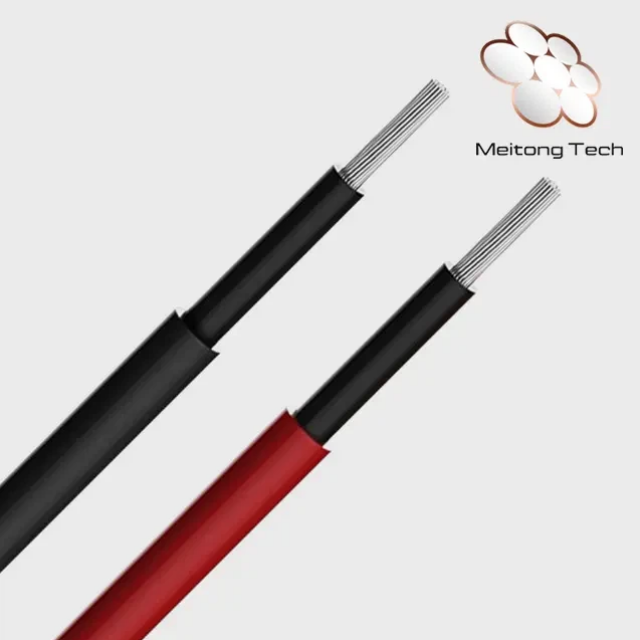
PV cables must meet or exceed the voltage and thermal requirements of the system. Residential systems often operate at 600V DC, whereas commercial and utility-scale systems may run at 1000V or even 1500V. Using cables rated below system voltage can compromise insulation integrity, leading to breakdowns, electrical hazards, or even fire.
Temperature ratings are equally critical. Solar panels generate heat during operation, and ambient temperatures can vary widely depending on climate. Cables that cannot withstand elevated temperatures may soften, crack, or degrade, increasing the risk of failure. High-quality PV cables from Meitong are designed to handle extended temperature ranges without compromising flexibility or insulation integrity. They maintain performance even under continuous high thermal stress, ensuring system longevity and safety.
Additionally, temperature-related derating must be considered. Current-carrying capacity reduces as cable temperature increases. Selecting cables with adequate thermal ratings prevents excessive heating and ensures compliance with international safety standards.
While the cable itself is important, connectors and lugs are equally crucial to long-term system performance. Even the best cable can underperform if paired with incompatible connectors or installed improperly. Common PV connectors, such as MC4, require precise crimping or soldering techniques. Poorly matched connectors can increase contact resistance, cause localized heating, or introduce failure points.
Ensuring proper compatibility between PV cables and connectors is critical. Pull tests, continuity checks, and torque verification during installation are simple yet effective ways to safeguard the integrity of the electrical path. Correct installation practices not only reduce energy losses but also help maintain warranty coverage for both cables and connectors.
Meitong PV cables are engineered to ensure reliable connector compatibility, which reduces resistance, maintains secure connections, and extends the overall lifespan of the solar system. High-quality connectors combined with premium PV cables create a system that is both efficient and resilient.
PV cables face diverse environmental challenges depending on installation conditions. Outdoor systems are exposed to sunlight, moisture, temperature extremes, and potentially corrosive chemicals. Indoor or underground systems face mechanical stress, temperature variation, and soil-related degradation. Choosing PV cables with the right environmental ratings ensures reliable performance.
Hot climates: UV-resistant insulation prevents degradation, and high-temperature ratings ensure safe operation under intense solar radiation.
Cold climates: Flexible insulation prevents cracking during handling or extreme cold conditions.
UV exposure: Double-sheath cables or UV-stabilized insulation prolong lifespan and maintain system reliability.
Burial applications: Cables rated for direct burial resist moisture, soil chemicals, and mechanical damage.
By understanding and addressing these environmental factors, installers can ensure PV cables maintain their conductivity, insulation integrity, and mechanical strength over decades of service.
When evaluating PV cables, measurable specifications provide insight into their quality and effectiveness:
Conductor CSA (cross-sectional area): Larger CSA reduces resistance, minimizes voltage drop, and limits heat buildup.
Insulation type & thickness: Determines mechanical durability, environmental resistance, and long-term thermal performance.
Voltage rating: Confirms suitability for different DC systems, including 600V, 1000V, and 1500V installations.
Temperature range: Ensures reliability under varying operational conditions.
Certifications: Compliance with international standards like IEC or UL guarantees safety and quality assurance.
Warranty terms: Demonstrates manufacturer confidence and assures long-term reliability.
Meitong PV cables are engineered with these specifications in mind, providing measurable advantages for efficiency, safety, and return on investment. Choosing cables that meet or exceed these criteria directly translates into fewer maintenance calls, lower energy losses, and enhanced system longevity.
Beyond basic specifications, system designers must consider:
Cable routing: Properly routed cables reduce stress, prevent sharp bends, and minimize exposure to external damage.
Current rating: Oversizing for potential future expansion avoids overheating and ensures safety margins.
Redundancy and monitoring: Using high-quality PV cables simplifies integration with monitoring systems, allowing for early detection of potential issues.
Taking a holistic approach to PV cable selection ensures that every aspect of the solar installation—from energy efficiency to safety and longevity—is optimized.
Selecting the right PV cables is not merely a technical choice—it is a strategic decision that directly influences the efficiency, safety, and long-term performance of solar installations. Meitong Conductivity Alloy Materials provides high-quality cables engineered to minimize voltage drop, resist environmental stress, and maintain secure electrical connections. By prioritizing performance-oriented specifications, engineers and installers can deliver safe, efficient, and reliable solar systems that maximize energy yield and reduce operational costs. For detailed datasheets, engineering support, or sample testing, contact us today to explore our high-performance PV cable solutions.
Q1: How do PV cables impact solar system efficiency?
PV cables influence efficiency through voltage drop and resistance. Using high-quality, properly sized cables reduces energy loss, delivering more power to the inverter.
Q2: Why is tinned copper preferred for PV cables?
Tinned copper offers superior corrosion resistance, flexibility, and durability, making it ideal for outdoor and long-term solar applications.
Q3: What voltage ratings should PV cables have?
PV cables should meet or exceed system DC voltage, commonly 600V, 1000V, or 1500V, to maintain insulation integrity and system safety.
Q4: How do environmental conditions affect cable selection?
Temperature, UV exposure, moisture, chemicals, and burial conditions determine insulation type, sheath material, and durability requirements to ensure long-term reliability.
Q5: How does cable sizing affect voltage drop?
Larger cross-sectional area (CSA) reduces resistance, minimizing voltage drop and heat buildup, which enhances efficiency and prolongs cable life.
Q6: What role do connectors play in PV cable performance?
Correct connectors ensure low resistance, secure connections, and long-term reliability. Mismatched or poorly installed connectors can cause heat, energy loss, and system failures.


