
Views: 0 Author: Site Editor Publish Time: 2025-08-25 Origin: Site


Designing cables for robotic arms and high-precision sensor systems requires careful consideration of both mechanical and electrical performance. For engineers and integrators working on industrial automation or robotics, selecting the right conductor material is crucial to achieving long-term reliability, signal integrity, and thermal stability. Silver Plated Copper Stranded Wire provides an ideal balance of conductivity, flexibility, and durability, while Silver Coated Copper Twisted Wire enhances high-frequency performance and EMI suppression. This article from Meitong Conductivity Alloy Materials (Jishui County) Co., Ltd. offers practical design guidance for robotic and sensor cables, covering flex life, thermal tolerance, contact resistance, EMI considerations, insulation selection, and installation best practices.
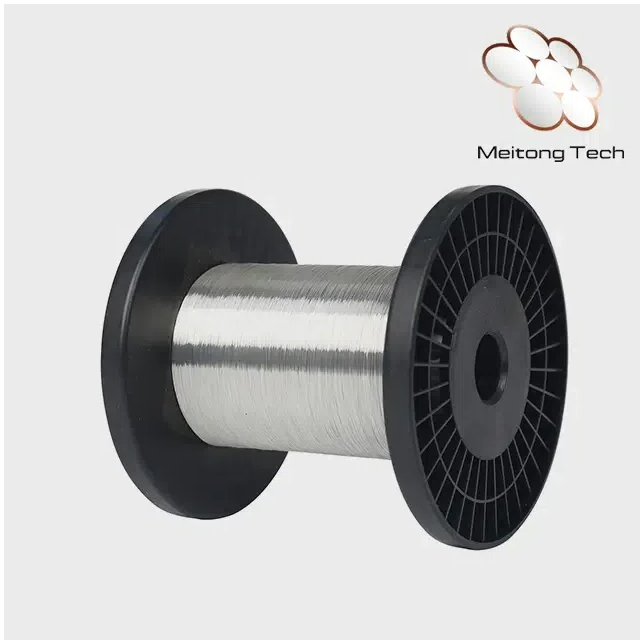
Robotic cables experience continuous motion, bending, and torsion, making flex life one of the most critical design factors. Stranded wire constructions allow conductors to bend repeatedly without breaking, which is essential for robotic arms, automated assembly lines, or sensor harnesses that undergo millions of cycles. Silver Plated Copper Stranded Wire combines the high conductivity of copper with a thin silver surface layer that resists oxidation, ensuring consistent performance over time.
For robotic applications, consider multi-strand configurations with fine gauge strands to improve flexibility without sacrificing conductivity. Using a combination of stranded cores with balanced lay directions reduces internal stress and minimizes strand fatigue. Twisting multiple Silver Coated Copper Twisted Wire cores can further enhance mechanical durability while maintaining excellent electrical performance for sensor lines carrying high-speed signals.
Industrial robots often operate near heat sources or in environments with elevated temperatures. Selecting a conductor with high thermal tolerance ensures reliable operation even under continuous exposure. Silver Plated Copper Stranded Wire can sustain temperatures up to 200°C, maintaining conductivity and preventing plating degradation.
When designing cables for high-temperature zones, pair silver-plated conductors with heat-resistant insulation such as PTFE, FEP, or silicone. These materials maintain flexibility while resisting thermal aging, providing long-term stability for both robotic and sensor cables.
Repeated connection cycles in robotic systems require low and stable contact resistance to prevent signal loss or power drop. Silver plating on copper not only reduces surface oxidation but also ensures reliable mating with connectors over thousands of cycles.
When specifying connectors, choose those designed for low-wear contacts compatible with silver-plated surfaces. Maintain consistent torque and alignment during assembly to maximize contact efficiency. For high-frequency sensor signals, maintaining tight contact is essential to avoid reflections or signal attenuation.
Industrial automation increasingly relies on high-speed sensor networks and communication lines. EMI and signal degradation can compromise precision, leading to errors in motion control or data acquisition. Silver Plated Copper Stranded Wire excels in reducing resistance and supporting high-frequency transmission, minimizing losses and maintaining signal fidelity.
For sensor leads and communication cables, using silver-coated conductors ensures minimal impedance variation and reduces susceptibility to electromagnetic interference. This is particularly important in densely packed cable bundles on robotic arms or within automated production lines.
Even with silver-plated cores, proper shielding is essential for EMI-sensitive applications. Braided or foil shields can be combined with Silver Plated Copper Stranded Wire to create robust protection against radiated and conducted interference.
Select shield coverage and weave density based on environmental exposure and signal frequency. Pairing plated cores with flexible shielded jackets maintains cable pliability while providing consistent EMC performance. In sensor cables transmitting high-frequency signals, this combination preserves signal integrity across dynamic motion.
Robotic cables often encounter oil, coolant, or cleaning agents in industrial environments. Insulation and jackets must resist chemicals, abrasion, and extreme temperatures. Recommended pairings include:
Silicone or FEP for high-temperature exposure
PVC or polyurethane for chemical resistance and mechanical toughness
Hybrid layers for multi-environment durability
Combining these materials with silver-plated conductors ensures mechanical robustness without sacrificing electrical performance. Careful material selection prevents premature insulation cracking, jacket wear, or conductor degradation.
Terminations are often the weakest point in flexible robotic cables. Strain relief devices and proper cable glands reduce bending stress at connectors, protecting the silver-plated surface from mechanical wear. For sensor harnesses, flexible boots and clamping systems prevent micro-movements that could increase contact resistance over time.
Design the assembly to maintain a continuous bend radius and reduce sharp kinks. This preserves plating integrity, ensuring consistent conductivity for both power and signal lines.
Robotic cable performance depends on proper installation and rigorous testing. Maintaining recommended bend radii prevents conductor fatigue and strand breakage. Acceptance tests should include:
Flex cycle testing under realistic motion patterns
Measurement of contact resistance before and after cycles
Signal integrity checks on sensor lines
Silver Plated Copper Stranded Wire performs consistently under repeated flex, but verifying durability with real-world testing ensures predictable operation.
Routine inspections extend cable lifespan and prevent unplanned downtime. Key inspection points include:
Visual checks for insulation cracking or abrasion
Connector wear or discoloration
Unusual changes in signal integrity or power drop
Replacing cables before failure, rather than after, maintains robotic precision and minimizes maintenance costs.
When requesting quotes, a concise specification ensures suppliers understand your requirements. Example:
"Robotic cable with 28 AWG Silver Plated Copper Stranded Wire, 0.1 mm strand diameter, continuous flex-rated to 5 million cycles, 200°C thermal tolerance. Insulation: FEP with polyurethane outer jacket, EMI shield braid 85% coverage, rated for high-speed sensor signals."
To verify quality, request test data including:
Number of flex cycles completed before resistance increase
Contact resistance measurements after repeated connector mating
High-frequency signal transmission tests
Thermal aging and chemical exposure results
Meitong Conductivity Alloy Materials (Jishui County) Co., Ltd. provides full test reports for Silver Plated Copper Stranded Wire, ensuring confidence in long-term robotic and sensor applications.
In conclusion, designing robotic and sensor cables with Silver Plated Copper Stranded Wire combines mechanical flexibility, thermal stability, low contact resistance, and superior EMI performance. Pairing these conductors with proper insulation, shielding, and termination strategies ensures high reliability in demanding industrial automation and robotic applications. For engineers seeking durable, high-performance cables, Meitong Conductivity Alloy Materials offers a wide range of silver-plated and twisted wire products with detailed QA documentation. Contact us to request sample flex-cycle data or download our ready-to-use robotic cable spec snippets to accelerate your design process.


