
Views: 0 Author: Site Editor Publish Time: 2026-09-05 Origin: Site


Reusable medical sensors operate in highly hostile clinical environments. They endure continuous flexing, heavy mechanical stress, and harsh sterilization cycles daily. This creates a massive engineering challenge. Standard consumer-grade conductors usually fail prematurely under these demanding conditions. They stretch, work-harden, and eventually snap. This leads to dangerous signal degradation, frequent false alarms, or catastrophic device failure during critical moments.
Component engineers and product managers face a tough sourcing goal. You must carefully balance electrical performance against mechanical fatigue limits. You also have to maintain strict regulatory compliance across the product lifecycle. Doing this correctly allows you to select a high-yield, long-lasting medical sensor lead wire. Ultimately, making the right material choices directly impacts patient safety. It also dictates clinical reliability and device uptime. In this guide, we will explore the critical properties required for these conductors. You will learn how to evaluate alloys, navigate compliance mandates, and choose the right manufacturing partner.
Signal integrity vs. durability: Standard copper offers high conductivity but poor fatigue resistance; specialized alloys are required for reusable applications.
Material selection is critical: Silver Plated BeCu Alloy Wire provides an optimal balance of tensile strength, flex life, and low impedance for high-fidelity biosignal transmission.
Compliance starts at the component level: Conductor reliability directly impacts EU MDR (e.g., MDCG guidelines) and FDA risk management requirements.
Supplier evaluation: True BoFU sourcing requires verifying a manufacturer's lot-to-lot consistency, custom stranding capabilities, and empirical fatigue-testing data.
Selecting medical components is never just an engineering exercise. It carries massive financial and clinical implications. Field failures directly disrupt hospital workflows. They also damage manufacturer reputations.
Hospitals continuously monitor their equipment replacement rates. Reusable diagnostic leads represent a significant recurring expense. When cables fail prematurely on the clinical floor, hospital procurement teams notice. They quickly pivot to alternative suppliers. For Original Equipment Manufacturers (OEMs), frequent field failures trigger expensive warranty claims. They also drain technical support resources. Building a reliable product protects your brand reputation. It ensures long-term contract renewals.
Conductor failure rarely happens all at once. It begins as microscopic fractures deep inside the cable jacket. As users bend and pull the wire, individual strands break. This reduces the functional cross-sectional area. Electrical impedance spikes immediately. In sensitive analog systems like ECG or SpO2 monitors, this impedance variation creates massive signal noise. Monitor algorithms struggle to filter this erratic noise. They trigger false clinical alarms. This phenomenon contributes heavily to alarm fatigue. It compromises patient diagnostics and endangers lives.
A true reusable medical device must survive punishing lifecycle requirements. We define these baseline metrics rigorously. A single sensor cable might undergo thousands of dynamic flex cycles per month. Nurses rapidly uncoil, stretch, and wrap these cables daily. Furthermore, infection control protocols demand aggressive chemical wipe-downs. Surgical cables often undergo repeated high-temperature autoclaving. Bare components must endure these mechanical and chemical stresses without degrading.
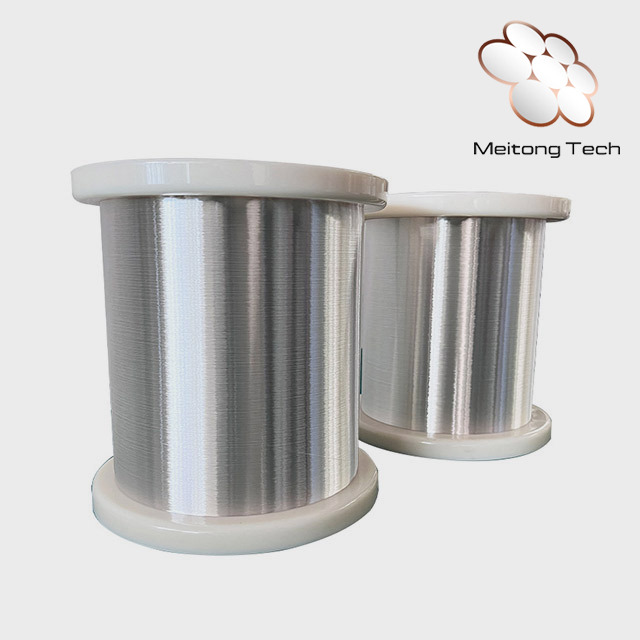
Engineers must evaluate several core parameters before specifying a conductor. You cannot rely on standard consumer wire specifications. Medical applications demand a highly specialized approach.
Mechanical Fatigue & Flex Life: You must evaluate both tensile strength and elongation. Reusable cables experience continuous dynamic flexing. They bend sharply near connectors and sensor nodes. Overcoming this requires specific stranding geometries. Engineers adjust the lay length (the twist pitch of the strands) to distribute mechanical strain evenly. Shorter lay lengths generally increase flexibility. They prevent individual strands from bearing the entire physical load.
Electrical Conductivity & Impedance: Biosignals operate at millivolt or microvolt levels. They require ultra-low resistance per meter to maintain fidelity. However, you must balance this need against miniaturization. High-density medical applications require very fine AWG (American Wire Gauge) sizes. Shrinking the wire diameter naturally increases resistance. Choosing the right advanced alloy helps solve this physical constraint.
Corrosion Resistance: Medical environments destroy bare metals. Conductors face constant exposure to moisture and bodily fluids. Sterilization processes also cause jacket outgassing. This outgassing can corrode copper from the inside out. Advanced plating solutions are non-negotiable. They seal the base metal away from corrosive agents.
Termination Compatibility: A cable is only as strong as its connections. Conductor properties must allow for highly reliable termination. You will connect these wires to delicate sensor nodes or multi-pin connectors. Common methods include crimping, micro-soldering, or ultrasonic welding. The chosen wire plating must form a stable, low-resistance metallurgical bond during termination.
Always request flex-life data specific to your expected bend radius.
Avoid solid-core wires completely for reusable dynamic applications.
Specify biocompatible jacketing materials alongside your core conductor requirements.
Material science solves the mechanical limitations of traditional conductors. Upgrading your raw materials directly extends the lifespan of your final device.
Pure copper dominates standard electronics because it conducts electricity efficiently. It is also highly affordable. However, pure copper presents severe limitations in high-flex, reusable medical environments. Copper is a highly ductile, soft metal. When subjected to repetitive bending, it undergoes rapid work-hardening. The internal grain structure deforms. The metal loses its flexibility and becomes brittle. Shortly after, the copper strands snap entirely. You cannot rely on pure copper for long-lasting dynamic sensor leads.
Engineers solve the copper fatigue problem by using advanced alloys. Beryllium Copper (BeCu) combines copper with a small percentage of beryllium. This simple addition completely transforms the mechanical properties. BeCu alloys deliver aerospace-grade tensile strength. They also possess exceptional mechanical memory. When you bend a BeCu strand, it aggressively resists permanent deformation. It returns to its original shape. This unique characteristic drastically extends the functional wire lifespan. It outlasts pure copper by orders of magnitude under dynamic stress.
Bare BeCu still requires a protective and conductive coating. Engineers apply specialized silver plating to achieve two crucial objectives:
Skin Effect & Signal Clarity: High-frequency electrical signals do not travel evenly through a wire. They concentrate along the outer surface. We call this the "skin effect." Silver acts as the most conductive metal available at room temperature. Plating the conductor with silver enhances high-frequency signal transmission. This characteristic proves critical for precision biological sensors.
Oxidation Defense: Bare alloys oxidize over time. Oxidation creates a highly resistive barrier. It ruins termination joints and degrades analog signals. Silver plating prevents this surface degradation. It ensures long-term solderability and stable crimp resistance.
The chart below outlines the key differences between these materials in a clinical application context.
Material Property | Standard Pure Copper | Silver Plated BeCu Alloy |
|---|---|---|
Tensile Strength | Low (Prone to stretching) | Exceptionally High |
Flex Life (Fatigue Resistance) | Poor (Work-hardens quickly) | Excellent (High mechanical memory) |
Signal Fidelity (High Frequency) | Moderate | Superior (Due to silver skin effect) |
Oxidation Resistance | Poor (Turns green/black) | High (Silver acts as a protective barrier) |
Termination Reliability | Degrades over time | Highly stable long-term joints |
Engineering teams must acknowledge the initial cost differences. Specifying Silver Plated BeCu Alloy Wire costs more upfront than standard copper. However, you must view this through a lifecycle lens. Premature cable failure costs significantly more. By minimizing field replacements, reducing warranty claims, and preventing misdiagnoses, specialized alloys deliver exceptional long-term return on investment.
Regulatory bodies no longer accept assumptions. They demand empirical proof of component reliability. Compliance always begins at the raw material level.
OEM compliance relies heavily on rigorous supplier transparency. You must maintain complete traceability for every spool of wire used in your medical devices. Manufacturers must supply valid material certifications. These include RoHS and REACH declarations. They confirm the absence of hazardous substances. You should also demand metallurgical test reports. These documents verify the exact alloy composition and plating thickness. Missing documentation halts device approval immediately.
ISO 14971 requires manufacturers to identify and mitigate clinical risks. Conductor failure represents a major documented risk. If a wire breaks, the monitor fails to read a patient's heart rate. You must align your conductor durability testing with these specific risk mitigation strategies. Using proven materials directly supports your risk management files. It proves you engineered the device to prevent known failure modes.
The European Medical Device Regulation (EU MDR) enforces strict lifecycle rules. We often reference MDCG (Medical Device Coordination Group) principles here. Component-level reliability ensures the final medical device meets General Safety and Performance Requirements (GSPR). Chapter 1 of the GSPR dictates that devices must perform safely throughout their entire intended lifetime. You cannot meet this requirement using inferior wires. Choosing highly durable alloys ensures your regulatory submissions withstand auditor scrutiny.
Accepting generic wire specifications without medical-specific validation data.
Failing to link raw material bend-testing to the final device's intended lifespan.
Overlooking the biocompatibility of the final extruded cable jacket.
Finding a wire manufacturer is easy. Finding a specialized medical component partner is difficult. You must rigorously evaluate their technical capabilities before placing an order.
Off-the-shelf wire rarely fits custom medical sensor applications. Your supplier must offer comprehensive custom stranding capabilities. Do they accommodate specific AWG requirements? Can they modify the twist pitch variations to maximize flexibility? Furthermore, evaluate their extrusion capabilities. They should offer biocompatible jacketing over the alloy. Medical-grade silicone and thermoplastic elastomers (TPE) represent the industry standard. The supplier must extrude these jackets seamlessly over your selected Medical Sensor Lead Wire.
Never rely on theoretical performance claims. Request verifiable, empirical data. A qualified manufacturer performs rigorous flex testing in-house. Look for "tick-tock" bend testing data. This involves bending the wire back and forth over a specific radius under load. Ask for rotational flex data as well. They should monitor impedance stability in real-time during these tests. If the resistance spikes early, the stranding configuration requires adjustment.
Medical device development requires aggressive iteration. Assess the supplier’s ability to provide rapid, low-volume prototyping. Can they deliver small sample runs without sacrificing tight physical tolerances? You need accurate prototypes to pass your internal validation tests. Once approved, the supplier must prove they can scale seamlessly to mass production. Lot-to-lot consistency remains critical as production volumes increase.
We encourage engineers to engage suppliers early in the design phase. Do not wait until the mechanical design is locked. Request sample spools. Set up a technical consultation with the manufacturer's metallurgy team. Review your specific bend-radius constraints and biological signal requirements. Early collaboration prevents costly redesigns later.
Summary: Selecting the right conductor property is not a commodity purchase. It represents a critical engineering decision. This choice dictates the actual lifespan and clinical safety of reusable diagnostic tools.
Final Recommendation: Standard copper simply cannot survive dynamic medical environments. Transitioning to specialized materials like silver-plated BeCu alloys minimizes clinical risk. It maximizes device uptime and signal fidelity.
Call-to-Action (CTA): Do you need to upgrade your sensor cables? Contact our engineering team today for a technical review of your specific sensor lead application, or reach out to request a comprehensive material specification sheet.
A: A suitable wire features extremely high flex life, low electrical noise, and strong resistance to environmental stress. It must survive rigorous sterilization cycles. Engineers usually achieve these characteristics through careful alloy selection, custom stranding geometries, and biocompatible jacketing.
A: Beryllium Copper (BeCu) provides superior mechanical strength and fatigue resistance. It survives repeated bending without snapping. Meanwhile, the silver plating ensures optimal surface conductivity for high-frequency signals. It also actively prevents oxidation at critical termination points.
A: Unreliable conductors inevitably lead to premature device failure. EU MDR requires devices to remain fully functional and safe throughout their specified lifecycle. Using validated, highly durable materials directly supports these strict risk-management and GSPR lifecycle performance requirements.
A: Yes. High-quality manufacturing partners allow extensive customization. You can define the specific strand count, lay length, and overall diameter. This allows you to meet precise flexibility requirements and navigate strict spatial constraints inside your sensor nodes.


