
Views: 0 Author: Site Editor Publish Time: 2026-08-30 Origin: Site


Industrial control cabinets house some of the most critical systems in modern manufacturing. Inside these enclosures, sensitive programmable logic controllers (PLCs) and variable frequency drives (VFDs) require robust protection from severe mechanical vibration and high-frequency electrical noise. Traditional solid or standard stranded grounding wires simply cannot withstand these dynamic conditions over time. They are highly susceptible to work-hardening and metal fatigue, often snapping right at the terminal junction. Moreover, standard round wire presents high-impedance barriers at high frequencies, leading to unexpected equipment faults or costly compliance inspection failures. Moving away from rigid wiring is absolutely vital for industrial reliability. Transitioning to a specified copper braided wire grounding strategy directly mitigates vibration-induced mechanical failure. It provides the essential low-impedance path required for effective EMI/RFI noise dissipation. In this article, you will discover how these specialized materials ensure continuous system uptime while effortlessly meeting strict NEC and UL safety guidelines.
Mechanical Resilience: The woven structure of copper braid absorbs multi-axial vibration, eliminating the localized stress points that cause solid wire fatigue in active machinery.
Superior EMI/RFI Dissipation: A flat braided profile maximizes surface area, leveraging the "skin effect" to efficiently route high-frequency noise from PLCs and VFDs to ground.
Compliance Certainty: Utilizing properly sized braided straps for enclosure doors and sub-panels simplifies compliance with rigorous industrial standards like UL 508A and NEC grounding requirements.
Strategic Material Selection: Specifying tinned copper braid over bare copper drastically reduces oxidation risks in harsh, high-humidity, or chemically exposed industrial environments.
Grounding failures in industrial control panels cause massive operational disruptions and hidden financial drains. When you rely on inadequate ground wiring, erratic sensor readings quickly emerge as a primary symptom. Poor grounding allows stray electrical noise to infiltrate sensitive analog measurement circuits. This interference masks actual signal data, confusing the PLC logic. As a result, facilities experience unexplained machine faults, dangerous operator safety hazards, and highly disruptive unplanned downtime. Financial impacts multiply rapidly when an entire high-speed packaging or stamping line stalls due to a single broken ground connection.
Standard stranded or solid wire has severe physical limitations in these environments. The physics of work-hardening explains why traditional wires inevitably fail. Constant cyclic loading occurs naturally near heavy motors, mechanical presses, or massive magnetic contactors. Vibration travels straight through the machine frame and into the panel enclosure. The continuous mechanical shaking bends standard wire back and forth repeatedly. Over time, the copper grain structure crystallizes and becomes highly brittle. It ultimately fractures precisely at the lug connection where the wire loses its flexibility.
You must establish strict success criteria for modern panel grounding. A reliable grounding solution must deliver continuous, ultra-low electrical impedance. At the same time, it must maintain absolute physical flexibility over a multi-year lifecycle. You should not have to perform frequent, intrusive maintenance inspections just to verify basic ground continuity. When engineered correctly, flexible solutions absorb the kinetic energy of the machine without transferring that stress to the termination points, ensuring uninterrupted safety and performance.
Mechanical flexibility defines the core advantage of a braided grounding strategy. The interwoven, multi-strand construction fundamentally changes how physical force acts upon the metal conductor. It distributes mechanical stress evenly across hundreds of micro-fine wires. Stress no longer concentrates at a single rigid terminal junction. When a machine vibrates aggressively, the braid simply shifts and absorbs the movement. It flexes harmlessly in multiple directions simultaneously, entirely bypassing the metal fatigue mechanisms that destroy solid cables.
High-frequency noise mitigation presents another massive challenge for modern panel builders. Variable frequency drives (VFDs) and switching power supplies generate immense electrical noise. This EMI/RFI interference does not travel through the center of a wire. Instead, it travels strictly on the outer surface of a conductor. Engineers call this phenomenon the "skin effect." A flat woven strap provides a significantly larger surface-area-to-volume ratio compared to thick, round standard cables. This dramatically expanded surface effectively minimizes high-frequency impedance. Consequently, harmful electrical noise drains quickly and safely away from sensitive logic circuits before it can cause data corruption.
Enclosure door applications highlight the absolute necessity of these flexible components. Heavy industrial cabinet doors frequently carry large Human-Machine Interface (HMI) screens, indicator lights, and numerous pushbuttons. You must securely bridge these moving electronic parts back to the main enclosure backplate. Flexible braids handle the constant swinging motion effortlessly. They maintain an unbroken, low-resistance ground path without snapping, catching, or degrading over thousands of opening and closing cycles.
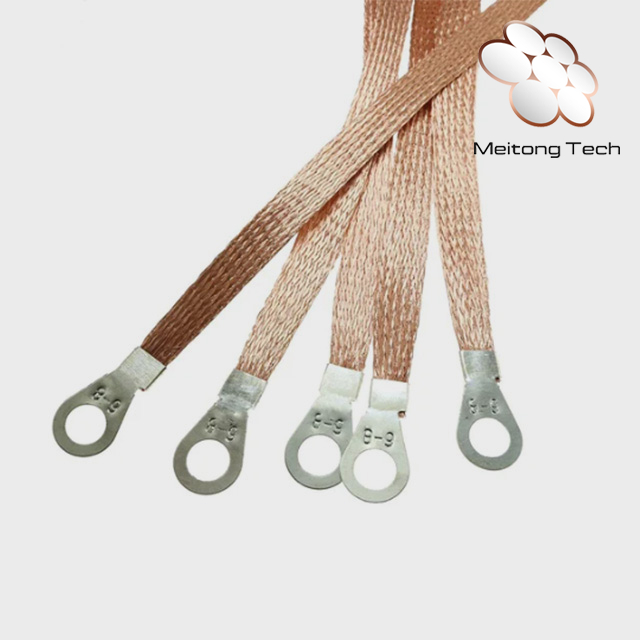
Choosing the correct material for your grounding straps requires accurate feature-to-outcome mapping. Engineers generally select between two primary options based on the specific installation environment. Understanding the distinct chemical properties of each type prevents premature system degradation.
Bare copper braided wire serves exceptionally well in controlled, dry, indoor environments. Think of climate-controlled server rooms or clean manufacturing spaces. It offers the absolute maximum baseline conductivity available. Engineers often specify bare copper when managing upfront material efficiency is a priority and the ambient humidity remains consistently low. However, bare copper reacts aggressively to moisture, airborne salts, and industrial chemicals, forming a green patina that ruins electrical continuity.
Conversely, Tinned Copper Braid is fundamentally essential for harsh industrial sectors. You must deploy it in high-humidity facilities, marine applications, or chemically aggressive environments like wastewater treatment plants. Manufacturers apply a specialized tin coating over every individual strand before weaving. This proactive coating completely prevents oxidation. Without it, oxidation would rapidly increase electrical resistance and degrade the grounding effectiveness, putting the entire panel at risk.
You must evaluate the lifecycle return on investment versus the upfront cost. Tinned copper naturally carries a slight material premium. Yet, it justifies this initial expense almost immediately. It drastically reduces mandatory maintenance intervals and eliminates premature strap replacements. You preserve facility capital by avoiding the severe downtime associated with chasing intermittent ground faults.
Follow a strict shortlisting logic for engineering procurement. Always assess the specific environmental conditions first, looking for moisture or corrosive gases. Next, calculate the required ampacity to ensure the strap handles potential short-circuit fault currents. Finally, check the maximum ambient operating temperature to guarantee the selected material will not degrade under heavy thermal loads.
Material Selection Comparison Chart
Feature | Bare Copper Braid | Tinned Copper Braid |
|---|---|---|
Primary Environment | Dry, climate-controlled, indoor | High-humidity, marine, chemical, outdoor |
Oxidation Resistance | Low (Prone to tarnishing and patina) | High (Tin coating acts as a chemical barrier) |
Upfront Material Cost | Standard baseline cost | Slightly higher premium |
Lifecycle Maintenance | Higher in unconditioned spaces | Minimal; highly stable over long durations |
High-Frequency Performance | Excellent skin effect utilization | Excellent skin effect utilization |
Compliance strictly dictates control panel safety and design architecture. UL 508A establishes rigorous requirements regarding the bonding and grounding of industrial control panels. The standard mandates that every metal component capable of becoming accidentally energized needs a reliable, continuous ground path. This includes doors, sub-panels, DIN rails, and gland plates. The standard leaves zero room for ambiguous wiring practices or improvised grounding attempts. Failing to adhere to these rules exposes operators to lethal shock hazards during a fault.
Authorities Having Jurisdiction (AHJ) perform thorough facility inspections prior to commissioning. Control panels frequently fail these routine safety checks due to oversight. Inadequate bonding of outer doors and internal sub-plates remains a leading reason for red-tag violations. Inspectors actively look for solid, uncompromised connections that can handle massive short-circuit currents. A frayed standard wire or a loosely bolted standard lug immediately flags the entire system for rejection and mandatory rework.
We highly recommend adopting an evidence-oriented application approach. Utilizing certified, pre-terminated copper braid straps provides inspectors with visual, unquestionable proof. They can immediately see a designated, low-impedance bond designed specifically for dynamic environments. Factory-crimped straps demonstrate a commitment to immediate compliance. This proactive strategy drastically reduces commissioning delays, prevents expensive last-minute electrical rework, and ensures the facility launches strictly on schedule.
Even the best grounding materials fail if installed incorrectly. Hardware and termination risks can easily ruin a compliant design. Using standard, lightweight lugs negates the mechanical flexibility of the braid entirely. Furthermore, improper crimping methods crush the fine copper strands, creating hidden weak points that will eventually snap. You must specify heavy-duty, properly torqued terminal rings. These specific rings secure the electrical connection robustly without damaging the delicate wire weave beneath the crimp.
Routing and installation require careful spatial planning within the crowded cabinet. Follow these established installation best practices to guarantee optimal performance:
Keep braid lengths as short and straight as physically possible. Shorter paths maintain the lowest possible impedance, which is critical for rapidly draining high-frequency noise.
Avoid introducing sharp creases or folding the flat braid abruptly. Hard creases introduce severe mechanical stress points, forcing the woven strands to fracture under vibration.
Leave a gentle, sweeping loop bridging the door to the backplate. The loop prevents the strap from stretching taut when the heavy enclosure door swings open completely.
Ensure the mating surface on the enclosure is completely free of paint, powder coat, or anodization before bolting the lug down.
Dissimilar metals pose a serious, often hidden threat to panel longevity. You risk severe galvanic corrosion if you bolt bare Copper Braided Wire straps directly to incompatible panel materials. When copper touches aluminum or galvanized steel in a humid environment, a destructive battery effect occurs. The metal physically eats away at the connection point, quietly destroying the ground path. You must utilize proper conductive anti-oxidant pastes, specialized bi-metallic lugs, or biting star washers. These components pierce surface oxides and prevent corrosive buildup from isolating the ground connection over time.
Revising your grounding strategy is a necessary step for modern manufacturing resilience. Choosing braided ground straps over standard rigid wire represents a highly intelligent engineering investment. It actively guarantees machine reliability, enforces strict safety compliance, and preserves crucial signal integrity against relentless high-frequency interference. You eliminate the mechanical fatigue that plagues dynamic machinery.
Take immediate action to secure your infrastructure. Audit your current high-vibration control panels to identify any frayed or stressed solid wire grounds. Calculate the exact required ampacity for each specific enclosure zone. Finally, consult with a specialized grounding supplier. They will assist you in specifying the precise width, length, and heavy-duty termination hardware required to keep your next panel build safe, compliant, and operational for years.
A: Standard wire meets basic electrical codes for stationary objects. However, cabinet doors move frequently. The repeated opening and closing action causes solid and stranded wire to work-harden. Eventually, those internal strands break near the lug. This creates a hidden loss of ground, jeopardizing operator safety and machine reliability.
A: Yes, it performs exceptionally well against high-frequency electrical noise. PLCs are highly sensitive to EMI/RFI generated by nearby drives. Noise travels on the surface of conductors due to the skin effect. The flat, woven surface area of a copper braid drains this interference far more effectively than standard round wire.
A: You must match the ampacity rating of the braided strap to the largest overcurrent protection device in that specific circuit. Always cross-reference the manufacturer’s specification tables with current NEC grounding guidelines. Ensure the strap handles potential fault currents safely without overheating or degrading the connection.


