
Views: 0 Author: Site Editor Publish Time: 2026-06-16 Origin: Site


Aerospace, medical device manufacturing, and high-frequency electronics operate under incredibly demanding conditions. Procurement decisions in these sectors carry high stakes. In these environments, uninterrupted signal integrity and absolute corrosion resistance remain non-negotiable. Even minor material degradation causes catastrophic system failures.
Unfortunately, many teams rely on superficial visual inspections when assessing materials. Naked-eye evaluations cannot detect microscopic plating inconsistencies. These hidden flaws inevitably lead to delayed field failures. They disrupt the skin effect, causing severe high-frequency signal attenuation. Furthermore, compromised coatings invite premature oxidation inside sealed environments.
Engineers and procurement specialists need an objective, repeatable framework. They must thoroughly evaluate internal specifications before committing to a long-term supplier. This guide outlines the exact metallurgical and mechanical factors you should analyze. We will explore substrate purity, plating concentricity, and rigorous compliance testing. You will learn exactly how to validate your next wire procurement properly.
High-frequency signal reliability relies entirely on strict silver plating thickness control and concentricity.
The purity of the copper core (e.g., Oxygen-Free Copper) dictates the mechanical workability and baseline conductivity before plating is applied.
Microscopic porosity and poor adhesion are the leading causes of wire degradation, requiring stringent surface quality validation.
Partnering with a certified conductive wire manufacturer that adheres to ASTM B298 standards mitigates long-term supply chain and compliance risks.
The core of any coated conductor defines its ultimate mechanical limitations. The base metal quality dictates how the final product performs under thermal and physical stress. Most premium applications rely on Oxygen-Free Copper (OFC) or Electrolytic Tough Pitch (ETP) copper. You cannot mask a poor-quality copper core using a high-quality silver shell.
OFC offers exceptional purity, typically exceeding 99.99% copper. This absence of oxygen prevents hydrogen embrittlement during high-temperature processing. ETP copper provides excellent baseline conductivity but contains trace amounts of oxygen. Choosing between them depends entirely on your thermal environment. When engineers specify the wrong base substrate, the conductor degrades rapidly. Copper purity establishes the baseline electrical conductivity before the plating process even begins.
Manufacturers must draw thick copper rods down to extremely fine gauges. Impurities inside the copper matrix create hard spots. These microscopic inclusions lead to sudden breaks during fine wire drawing. Frequent wire breaks halt production lines and severely affect production yield. Furthermore, an impure copper core reduces the final tensile strength. When technicians subject the finished wire to mechanical tension, hidden internal flaws cause unexpected snapping.
Substrate preparation matters just as much as material purity. A poorly prepared copper surface directly causes adhesion failures down the line. If oxides or oils remain on the raw copper, the silver layer cannot form a proper metallurgical bond. Peeling and blistering will occur regardless of how much silver you apply. Careful chemical etching and cleaning steps remain vital for ensuring long-lasting bond integrity.
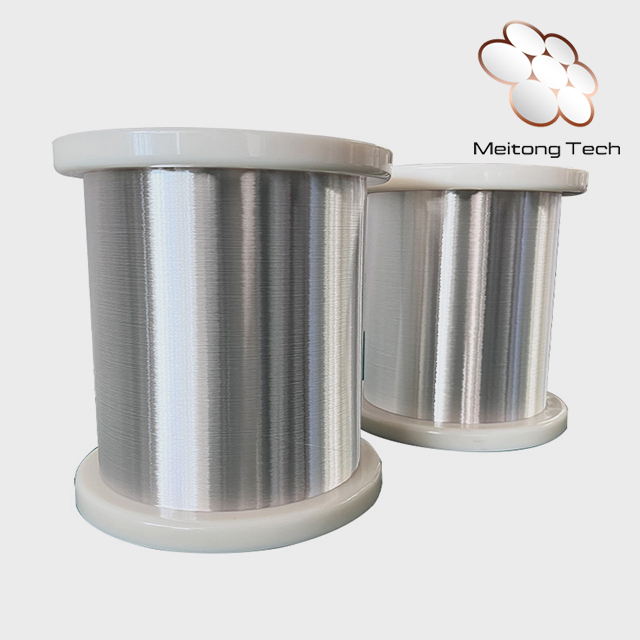
Engineers must look beyond the simple percentage of silver by weight. High-performance applications demand absolute geometric precision across the entire conductor surface. Inconsistent plating directly threatens the operational lifespan of advanced electronic assemblies.
High-frequency transmission realities dictate strict engineering requirements. In systems like PTFE coaxial cables, alternating currents do not travel uniformly through the entire conductor cross-section. Instead, electrons crowd along the outer edge. We call this phenomenon the skin effect. Because current concentrates on the surface, the outer silver layer carries the majority of the high-frequency signal. Consequently, silver plating thickness control becomes critical to maintaining signal integrity. If the layer thins out, the signal penetrates into the less conductive copper core, causing massive attenuation.
Many suppliers market their products based purely on total silver weight. However, total mass is a flawed and misleading metric. You could technically achieve a 4% silver weight while leaving one side of the wire completely bare. Continuous, uniform concentricity around the entire circumference defines true silver plated copper wire quality. Engineers need equal plating thickness at every point along the 360-degree axis to prevent localized signal loss.
Achieving perfect concentricity requires immense manufacturing discipline. Several primary variables dictate thickness consistency during production:
Electroplating Bath Chemistry: The exact balance of silver cyanide, potassium cyanide, and proprietary brighteners controls deposition rates.
Voltage Regulation: Micro-fluctuations in electrical current create uneven plating zones. Rectifiers must maintain absolute stability.
Line Speed: The speed at which wire travels through the chemical bath determines total exposure time. Faster speeds require higher currents, which increases the risk of nodule formation.
When suppliers fail to monitor these three variables simultaneously, they produce wire with severe microscopic inconsistencies.
Surface perfection extends far beyond aesthetics. The microscopic topography of the wire dictates its resistance to environmental decay. You must evaluate how the coating holds up under intense mechanical manipulation.
Porosity acts as a silent killer in electrical systems. Microscopic gaps in the plating expose the underlying copper core to oxygen and moisture. This exposure initiates a severe reaction known as galvanic corrosion. Because silver and copper possess different electrochemical potentials, the copper acts as an anode and corrodes rapidly. This creates "red plague" or cuprous oxide. Red plague eats through the conductor, ultimately destroying the connection. Eliminating porosity remains the only way to prevent this chemical degradation.
Raw wire rarely stays perfectly straight in the field. Downstream processing subjects the conductor to immense mechanical stress. Manufacturing steps include stranding, tight braiding, and high-pressure extrusion. Flawless silver plated copper wire surface quality prevents the coating from flaking during tight-radius bending. If the silver separates from the copper during crimping or routing, the exposed core becomes an immediate failure point. Proper adhesion ensures the metals stretch and bend as a single unified structure.
Procurement teams often misinterpret surface appearance. Acceptable cosmetic variations exist between batches. For example, some baths produce a matte finish, while others yield a bright finish depending on specific chemical additives. Neither finish inherently implies poor quality. However, critical structural defects require rejection. You must watch out for:
Nodules: Rough, raised bumps of excess silver that tear insulation.
Pits: Micro-craters exposing the bare copper substrate underneath.
Blistering: Bubbles indicating trapped gases and zero metallurgical adhesion.
Trusting a supplier's marketing claims invites severe operational risk. You must demand rigorous, standardized testing documentation for every delivery. The aerospace and medical industries rely on specific frameworks to guarantee consistency.
The industry gold standard is ASTM B298. This specification governs silver-coated soft or annealed copper wire. It standardizes quality expectations across the globe. The standard categorizes wire into specific class designations based on minimum silver percentages. Class A requires 1.25% silver, Class B dictates 2.5%, Class C mandates 4%, and Class D requires 6.1%. Adherence to ASTM B298 guarantees the material meets fundamental baseline requirements for both thickness and purity.
Quality assurance requires a multi-faceted testing approach. Reputable facilities utilize several distinct methodologies to validate different physical properties.
Test Method | Primary Function | Defect Detected |
|---|---|---|
Sodium Polysulfide Test | Checks plating continuity across the surface. | Microscopic porosity and exposed copper. |
Wrap Test (Adhesion) | Verifies mechanical bond strength. | Flaking, cracking, or peeling under stress. |
X-Ray Fluorescence (XRF) | Validates exact coating depth objectively. | Inconsistent thickness and poor concentricity. |
During the polysulfide test, technicians dip the wire into a reactive solution. If any copper remains exposed through porous silver, it immediately turns black. The wrap test forces the wire to coil tightly around a mandrel of its own diameter. If the silver flakes, the batch fails. Finally, XRF provides non-destructive, highly accurate thickness measurements down to the micro-inch.
Consistency from one spool to another is vital for large-scale manufacturing. You must emphasize the importance of documented test reports. Request a Certificate of Analysis (CoA) for every single spool. Batch traceability ensures you can isolate and recall specific lots if a rare anomaly occurs years later.
Selecting the right supply partner determines your long-term success. The capabilities of their facility directly correlate to the reliability of your finished products. A thorough evaluation process prevents costly supply chain disruptions.
Always conduct a thorough facility audit before signing a contract. Look closely at their vertical integration. Facilities performing in-house drawing alongside in-house plating offer vastly superior quality control. When a supplier outsources the plating step, they lose custody of the material, introducing massive contamination risks. Furthermore, verify their environmental controls and cleanroom standards. Ensure they hold active ISO 9001 and AS9100 certifications, proving their processes meet stringent aerospace quality management standards.
Avoid suppliers who push standard inventory to meet unique engineering challenges. Assess their ability to customize plating percentages based on your specific requirements. You might need exactly 1.25%, 2%, 4%, or 10% silver depending on distinct thermal parameters or conductivity targets. A capable facility adjusts bath chemistry and line speeds to deliver custom solutions rather than forcing you to accept off-the-shelf compromises.
Partnering with a certified conductive wire manufacturer mitigates immense supply chain risk. Reputable partners provide highly predictable lead times, protecting your production schedules. They offer transparent material sourcing, proving they do not use conflict minerals or degraded scrap copper. Most importantly, elite manufacturers provide comprehensive failure-analysis support. If a field issue arises, they partner with you to conduct metallurgical reviews and resolve the root cause collaboratively.
Specifying high-performance wire requires engineers to look far past basic wire gauge dimensions and initial price tags. Reliable signal transmission and long-term durability depend heavily on microscopic thickness uniformity and flawless substrate preparation. When you ignore concentricity or porosity, you invite rapid galvanic corrosion and high-frequency signal loss into your crucial systems.
Take actionable steps to protect your next procurement cycle. Advise your procurement teams to request complete XRF testing data and sodium polysulfide continuity test results upfront. Do not rely on visual inspections alone. Always request prototype spools for internal validation and rigorous mechanical testing before scaling up to bulk production orders. By enforcing these strict metallurgical standards, you guarantee uninterrupted performance in the field.
A: High-frequency signals travel primarily along the outer surface of a conductor due to the skin effect. Precise, uniform silver plating ensures the current travels through the highly conductive silver layer. If the plating is too thin or uneven, the signal penetrates the less conductive copper core, resulting in severe signal attenuation and data loss.
A: Red plague is a destructive form of galvanic corrosion that creates cuprous oxide. It occurs when microscopic porosity in the silver plating exposes the underlying copper core to moisture and oxygen. High-quality wire prevents this by ensuring flawless, non-porous plating continuity, completely sealing the copper away from environmental exposure.
A: Technicians test adhesion using standard wrap or bend tests. They coil the finished wire tightly around a cylindrical mandrel that matches the wire's own diameter. After wrapping, they examine the outer surface under magnification. If the silver coating cracks, peels, or flakes off the copper substrate, the material fails the adhesion test.
A: No. Brightness is simply an aesthetic result of proprietary chemical brighteners added to the electroplating bath. A matte finish often offers better elemental purity and superior solderability. You should judge quality based on objective metrics like thickness concentricity and porosity, rather than visual shine.


